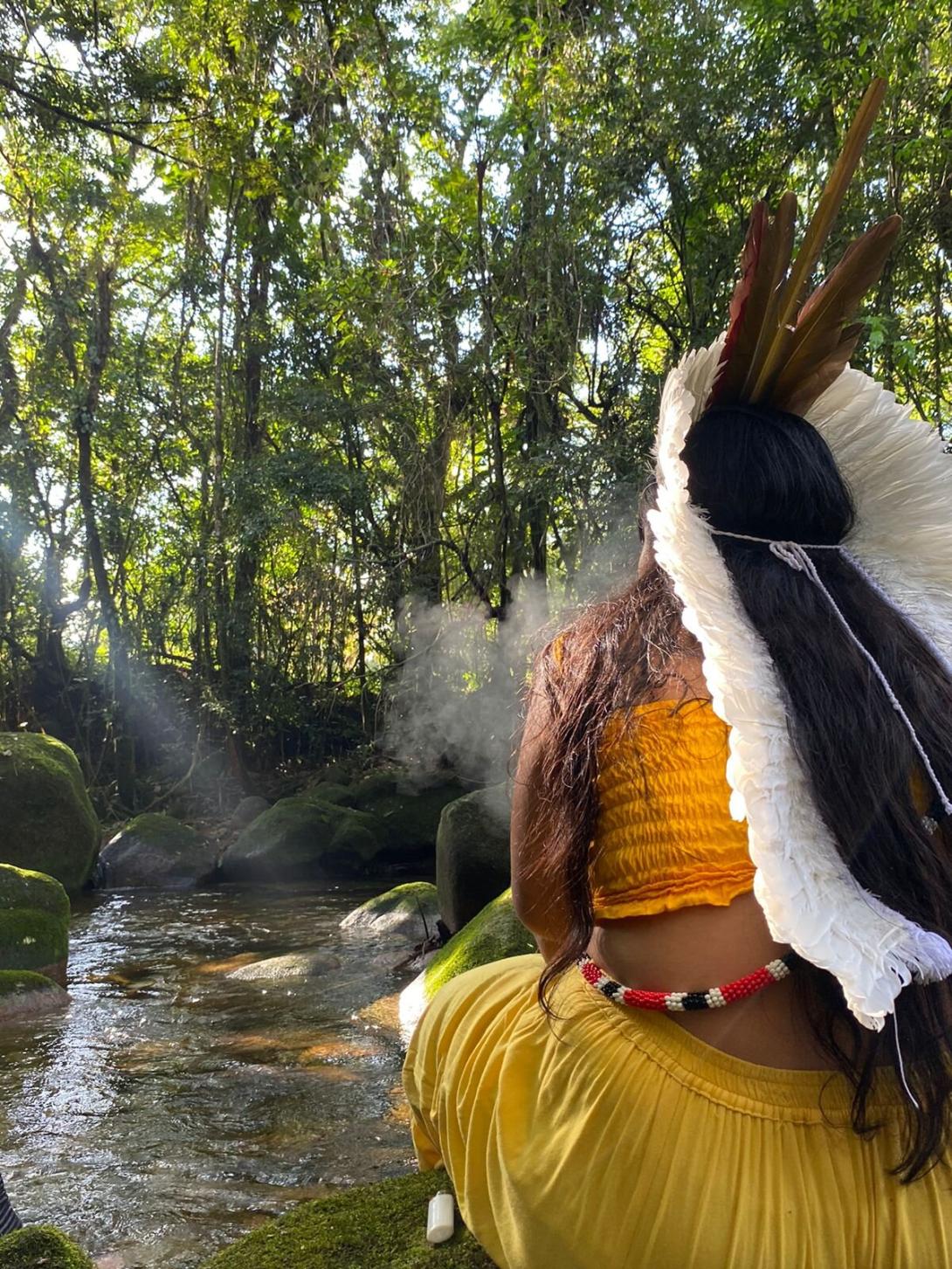
Photo: Albori Ribeiro. Source: Viaje Paraná — coverage of “Ancestralidade: Cultura Indígena no Ekôa com Ju Kerexu”, an experience centered on Guarani culture and traditional knowledge at Ekôa Park, in Morretes, Paraná.
Indigenous presence, territory and living culture across Paranaguá, Pontal do Paraná, Morretes and Guaraqueçaba.
This page provides an educational overview of Indigenous presence on the Paraná coast, with particular attention to the Guarani Mbya communities of Paranaguá, Pontal do Paraná, Morretes and Guaraqueçaba. Its purpose is to recognize living Indigenous cultures while respecting authorship, identity, memory, territory and the right of communities to represent themselves.
Indigenous Presence on the Paraná Coast
The Paraná coast has a long Indigenous history that predates European colonization and remains alive today. Guarani Mbya communities maintain territories, family networks, language, spirituality and cultural practices throughout the coastal region and beyond.
In a 2021 report, the National Foundation of Indigenous Peoples — FUNAI recorded seven Indigenous villages in the coastal municipalities of Morretes, Guaraqueçaba, Pontal do Paraná and Paranaguá, identifying the Guarani Mbya as the predominant Indigenous people in those communities.
Guarani Mbya territoriality extends beyond the boundaries of an individual village. Family, social, spiritual and cultural relationships connect communities across the Paraná coast and with other Guarani territories in southern and southeastern Brazil and neighboring countries.
Communities and Territories
Among the territories documented in the region are Ilha da Cotinga, in Paranaguá, and Sambaqui, in Pontal do Paraná, together with other Guarani Mbya communities across Morretes and Guaraqueçaba.
Ilha da Cotinga — Paranaguá
The Ilha da Cotinga Indigenous Land is inhabited by Guarani Mbya and is one of the best-documented Indigenous territories on the Paraná coast. Its official recognition was homologated in 1994.
The Tekoa Pindoty community on Ilha da Cotinga has also been the subject of anthropological and ethnoarchaeological research by the Federal University of Paraná.
Sambaqui — Pontal do Paraná
The Sambaqui Indigenous Land, located in Pontal do Paraná, is traditionally occupied by the Guarani Mbya. FUNAI published studies concerning the identification and delimitation of the territory in 2016.
Official documentation describes historical Guarani Mbya movement and occupation along the Paraná coast and emphasizes the importance of understanding these territories as part of broader networks of kinship, mobility and cultural continuity.
Morretes and Guaraqueçaba
Guarani Mbya communities are also present in Morretes and Guaraqueçaba. FUNAI records communities and territories including Cerco Grande and Kuaray Haxa within this wider coastal network.
These communities should not be understood as isolated settlements, but as parts of interconnected Guarani social and territorial networks.
Living Culture and Traditional Knowledge
Guarani Mbya culture is contemporary and living. It includes language, spirituality, oral traditions, relationships with territory, artistic expression, community organization and knowledge transmitted between generations.
Traditional and contemporary material culture may include basketry, woodwork, adornments, musical practices and other objects connected with community life, cultural expression and relationships with the natural environment.
A collaborative exhibition organized by the Museum of Archaeology and Ethnology of the Federal University of Paraná presented aspects of Guarani Mbya daily life, art, cosmology and spirituality together with communities from Ilha da Cotinga, Sambaqui, Cerco Grande and Morretes.
These practices should not be treated simply as historical artifacts or folklore. They belong to living peoples who continue to create, teach, adapt and define their own cultures.
Territory and the Atlantic Forest
For the Guarani Mbya, territory cannot be understood only through property boundaries or administrative maps. Research and official Indigenous territorial studies describe relationships involving family networks, spirituality, mobility, natural resources and places of cultural significance.
Many Guarani territories on the Paraná coast are located within the Atlantic Forest, creating an important relationship between Indigenous rights, cultural continuity and biodiversity conservation.
Indigenous presence and environmental conservation should not automatically be understood as competing interests. Recent agreements involving the Guarani Mbya community of Tekoa Kuaray Haxa and federal conservation authorities demonstrate efforts to reconcile conservation objectives with Indigenous territorial rights and ways of life.
Contemporary Challenges
Indigenous communities on the Paraná coast face different challenges according to the legal status, location and history of each territory.
- Territorial recognition and land regularization processes at different administrative stages;
- Infrastructure and development pressures affecting coastal territories;
- Interaction and, in some areas, overlap between Indigenous territories and conservation units;
- The need to protect language, cultural knowledge and territorial continuity;
- Limited public knowledge about the contemporary Indigenous presence on the Paraná coast.
Cultural Tourism and Indigenous Authorship
Indigenous cultural experiences can contribute to education and public understanding when they are developed with Indigenous leadership, consent and authorship.
One example was the “Ancestralidade: Cultura Indígena no Ekôa com Ju Kerexu” program held at Ekôa Park in Morretes. The activities were conducted by Ju Kerexu, a Guarani Mbya leader, teacher of the Mbya-Guarani language, poet and Indigenous activist born in the Ilha da Cotinga Indigenous Land.
The program included Guarani cultural knowledge, oral narratives, handicrafts, music, food and traditional understandings of nature, providing an example of tourism connected with Indigenous participation rather than simply using Indigenous culture as an external attraction.
Our Approach
Ilha do Mel Nativo recognizes that information about Indigenous peoples should be presented with care. Our role is not to speak on behalf of Guarani Mbya communities, but to acknowledge their presence and direct readers toward Indigenous, academic and official sources.
When addressing Indigenous history and culture, we seek to follow several basic principles:
- Use educational content supported by official records and academic research;
- Recognize that Indigenous communities are living contemporary societies, not only part of the historical past;
- Clearly identify communities and territories when the information is public and appropriate;
- Respect Indigenous authorship, consent and self-representation;
- Avoid speaking on behalf of communities or presenting cultural knowledge as our own.
Language and Terminology
In English-language content, we use terms such as Indigenous people, Indigenous peoples, Indigenous community and the specific name of the people concerned — in this case, Guarani Mbya. We capitalize Indigenous and avoid generic or outdated terminology when a community's own identity can be stated more precisely.
References and Further Reading
- FUNAI — Indigenous communities on the Paraná coast
FUNAI supports the autonomy of Indigenous communities on the Paraná coast - FUNAI — Sambaqui Indigenous Land
Identification studies concerning the Sambaqui Indigenous Land - Federal University of Paraná — UFPR
Ethnoarchaeology of the Mbya Guarani at Tekoa Pindoty, Ilha da Cotinga - RELA Cult — Latin American Journal of Cultural and Social Studies
Research concerning a Mbya Guarani village on the Paraná coast - Fiocruz — Conflict Map
Records concerning the Guarani community of Kuaray Haxa and territorial issues - Instituto Socioambiental — Indigenous Peoples in Brazil
Guarani Mbya - Terras Indígenas no Brasil — Instituto Socioambiental
Ilha da Cotinga Indigenous Land - Viaje Paraná
Indigenous cultural tourism experience in the Grande Reserva Mata Atlântica
Comentários